Abstract Syntax Notation One (ASN.1): History, Encodings, and C Implementation
Data serialization standards come and go, but few have stood the test of time like Abstract Syntax Notation One (ASN.1). Designed decades before JSON, Protocol Buffers, or FlatBuffers, ASN.1 remains the backbone of critical digital infrastructure—powering everything from X.509 security certificates and HTTPS encryption to cellular phone networks (3G/4G/5G).
This comprehensive guide explores the history of ASN.1, where it is used today, how Tag-Length-Value (TLV) binary formats work, a full source code implementation in C using asn1c, and how to decode binary ASN.1 structures online.
1. History of ASN.1
ASN.1 was originally standardized in 1984 by the CCITT (now ITU-T) under recommendation X.409 as part of early electronic mail messaging standards. In 1988, due to its versatility, ASN.1 was split into its own dedicated standard series:
- ITU-T X.680 series / ISO/IEC 8824: Defines the ASN.1 abstract syntax notation language.
- ITU-T X.690 series / ISO/IEC 8825: Defines binary and textual encoding rules (BER, DER, CER, PER, XER).
The fundamental goal of ASN.1 was machine independence. In the early days of computing, hardware architectures differed wildly in endianness (big-endian vs. little-endian), integer byte widths (16-bit, 32-bit, 36-bit, 64-bit), and memory alignment. ASN.1 provided an abstract Interface Definition Language (IDL) to describe complex data structures regardless of platform hardware.
2. Where is ASN.1 Used Today?
Despite being introduced in the 1980s, ASN.1 is omnipresent in modern software and telecommunications:
Cryptography & Public Key Infrastructure (PKI):
- X.509 Certificates: Digital certificates used for SSL/TLS, HTTPS web traffic, and secure email (S/MIME).
- Cryptographic Keys & Structures: PKCS standards (PKCS #1, PKCS #7, PKCS #8, PKCS #12) and RSA/ECC key structures are encoded using ASN.1 DER format.
Telecommunications & Cellular Networks:
- 3GPP Standards: Signaling protocols for GSM, 3G, 4G LTE, and 5G NR (e.g., Radio Resource Control / RRC, NAS messages) rely heavily on ASN.1 Packed Encoding Rules (PER) for ultra-low bandwidth consumption over radio channels.
Network Management & Directory Services:
- SNMP (Simple Network Management Protocol): Used to monitor and manage routers, switches, and network devices.
- LDAP (Lightweight Directory Access Protocol): Centralized directory and identity management queries.
Financial & Smart Card Infrastructure:
- EMV Smart Cards: Payment chips on credit and debit cards use ASN.1 BER structures to exchange cryptograms with payment terminals.
3. ASN.1 Formats and Encoding Rules
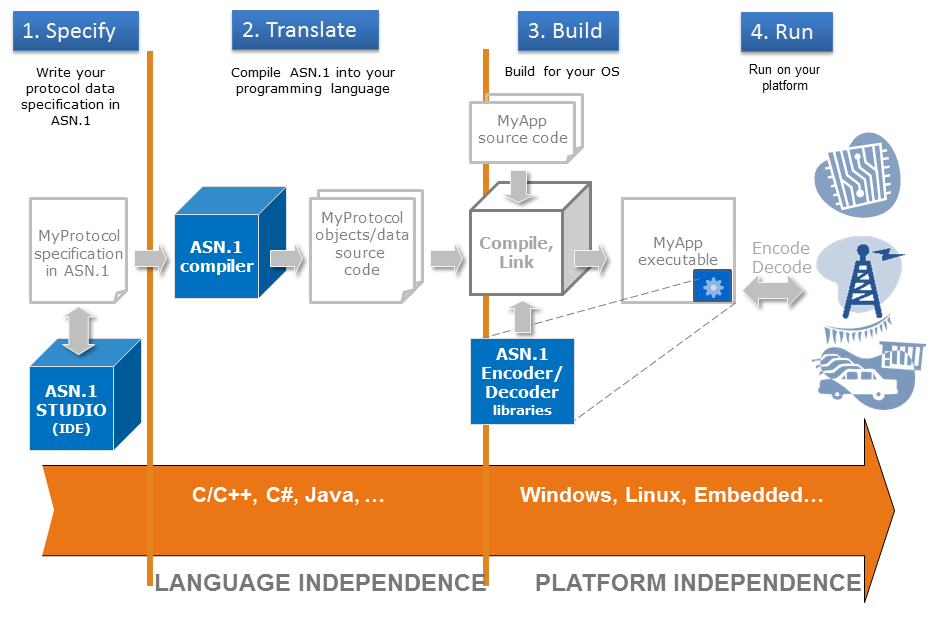
ASN.1 separates the abstract definition of a data structure from its transfer encoding rule. You define data once in an .asn schema file, then choose an appropriate encoding rule based on performance, bandwidth, or cryptographic determinism.
+-------------------------------------------------------------------------+
|                           ASN.1 ARCHITECTURE                            |
+-------------------------------------------------------------------------+
| Abstract Definition (.asn)                                              |
| UserProfile ::= SEQUENCE { id INTEGER, username UTF8String }           |
+-------------------------------------------------------------------------+
                                   |
           +-----------------------+-----------------------+
           |                                               |
           v                                               v
Binary Encodings (BER / DER)                    Packed Encodings (PER)
[Tag] [Length] [Value]                          [Bit-level packed fields]
Key Encoding Rules
- BER (Basic Encoding Rules): The original binary format using Tag-Length-Value (TLV) layout. Flexible, allowing multiple representations for the same data.
- DER (Distinguished Encoding Rules): A strict subset of BER. Ensures a deterministic, canonical encoding—meaning a given data structure produces exactly one unique byte sequence. This is essential for digital signatures and cryptographic hashing.
- CER (Canonical Encoding Rules): Similar to DER, but optimized for streaming large data structures using indefinite length encodings.
- PER / UPER (Packed Encoding Rules / Unaligned PER): Strips away Tag and Length headers when field sizes are fixed or bounded in the schema. Yields ultra-compact binary streams for bandwidth-constrained environments (e.g., 5G radio networks).
- XER (XML Encoding Rules): Encodes ASN.1 structures into human-readable XML documents.
4. Understanding TLV Structure (Tag-Length-Value)
In BER and DER encodings, every field is serialized into three sequential components:
+-------------------------------------------------------------+
| TAG (Type)       | LENGTH (Bytes)   | VALUE (Content Data) |
| e.g., 02 (INTEGER)| e.g., 02 (2 bytes)| e.g., 04 D2 (1234)   |
+-------------------------------------------------------------+
Example: Encoding an Integer (1234)
- Tag:
0x02(Standard Universal Tag forINTEGER) - Length:
0x02(Value length is 2 bytes) - Value:
0x04 0xD2(1234in hexadecimal: $0x04 imes 256 + 0xD2 = 1234$) - Complete Hex Byte Stream:
02 02 04 D2
5. Sample Schema Definition (.asn)
Here is an example ASN.1 module defining a UserProfile structure:
UserProfileModule DEFINITIONS AUTOMATIC TAGS ::= BEGIN

UserStatus ::= ENUMERATED {
    inactive(0),
    active(1),
    suspended(2)
}

UserProfile ::= SEQUENCE {
    userId      INTEGER,
    username    UTF8String,
    email       UTF8String OPTIONAL,
    status      UserStatus
}

END
6. Implementation in C Language using asn1c
asn1c is a widely used open-source ASN.1 compiler that reads .asn schemas and generates native C code headers and sources for BER, DER, and PER encoding/decoding.
Step 1: Install asn1c
- Ubuntu / Debian:
sudo apt-get install asn1c - From Source (GitHub):
git clone https://github.com/vlm/asn1c.git
cd asn1c && autoreconf -iv && ./configure && make && sudo make install
Step 2: Generate C Bindings from Schema
Save the schema above as UserProfile.asn and run:
asn1c -pdu=UserProfile UserProfile.asnThis command generates C struct definitions, serialization routines, and helper files (UserProfile.h, UserProfile.c, ber_decoder.h, der_encoder.h, etc.).
Step 3: C Source Code (main.c)
Here is a full C program that instantiates a UserProfile struct, encodes it to binary DER format, prints the hex payload, and decodes it back.
#include <stdio.h>
#include <stdlib.h>
#include "UserProfile.h"

int main() {
    // 1. Allocate and initialize UserProfile struct
    UserProfile_t *profile = calloc(1, sizeof(UserProfile_t));
    if (!profile) {
        perror("Failed to allocate memory");
        return EXIT_FAILURE;
    }

    // Populate userId (INTEGER)
    asn_long2INTEGER(&profile->userId, 12345);

    // Populate username (UTF8String)
    OCTET_STRING_fromBuf(&profile->username, "john_doe", -1);

    // Populate status (ENUMERATED)
    profile->status = UserStatus_active;

    // Optional email field (leave NULL or set string)
    profile->email = calloc(1, sizeof(UTF8String_t));
    OCTET_STRING_fromBuf(profile->email, "john@example.com", -1);

    // 2. Encode struct to DER binary format
    uint8_t buffer[256];
    asn_enc_rval_t er = der_encode_to_buffer(&asn_DEF_UserProfile, profile, buffer, sizeof(buffer));

    if (er.encoded == -1) {
        fprintf(stderr, "Failed to encode UserProfile structure
");
        ASN_STRUCT_FREE(asn_DEF_UserProfile, profile);
        return EXIT_FAILURE;
    }

    printf("DER Encoded Binary Size: %zd bytes
", er.encoded);
    printf("Hex Payload: ");
    for (size_t i = 0; i < er.encoded; i++) {
        printf("%02X ", buffer[i]);
    }
    printf("

");

    // Free original struct
    ASN_STRUCT_FREE(asn_DEF_UserProfile, profile);

    // 3. Decode binary DER buffer back into struct
    UserProfile_t *decoded_profile = NULL;
    asn_dec_rval_t rval = ber_decode(0, &asn_DEF_UserProfile, (void **)&decoded_profile, buffer, er.encoded);

    if (rval.code != RC_OK) {
        fprintf(stderr, "Broken UserProfile DER encoding at byte %ld
", (long)rval.consumed);
        return EXIT_FAILURE;
    }

    // 4. Print decoded data
    long user_id;
    asn_INTEGER2long(&decoded_profile->userId, &user_id);

    printf("--- Decoded ASN.1 UserProfile ---
");
    printf("User ID  : %ld
", user_id);
    printf("Username : %.*s
", (int)decoded_profile->username.size, decoded_profile->username.buf);
    if (decoded_profile->email) {
        printf("Email    : %.*s
", (int)decoded_profile->email->size, decoded_profile->email->buf);
    }
    printf("Status   : %ld
", (long)decoded_profile->status);

    // Clean up memory
    ASN_STRUCT_FREE(asn_DEF_UserProfile, decoded_profile);

    return EXIT_SUCCESS;
}
Compiling and Running
# Compile C source files with GCC
gcc -I. -o asn1_demo main.c *.c

# Run binary executable
./asn1_demo
7. Online ASN.1 Decoder Tool
Because raw ASN.1 binary data (BER/DER) consists of nested Tag-Length-Value structures, inspecting binary payloads manually can be complex.
To quickly inspect, decode, and parse hexadecimal or Base64 ASN.1 byte streams, use our interactive online decoder:
👉 ASN.1 Online Decoder Tool on mitos.dev
With this utility, you can:
- Paste raw hex or Base64 ASN.1 strings (such as X.509 certificates, SSL keys, or custom BER/DER streams).
- Inspect the visual tree structure of Tag, Length, and Value fields down to deep nested levels.
- Instantly verify data structures during backend or protocol development.
8. Summary Comparison: ASN.1 vs JSON vs Protobuf
| Feature | ASN.1 (DER / PER) | JSON | Protocol Buffers (Protobuf) |
|---|---|---|---|
| Data Format | Binary (TLV or Packed) | Human-readable Text | Binary (Field Tagged) |
| Schema Required? | Yes (.asn) |
No (Optional JSON Schema) | Yes (.proto) |
| Deterministic Canonical Form | Yes (DER) | No | No (Requires custom ordering) |
| Primary Domain | Cryptography, Telecom, PKI | Web APIs, Web Apps | Microservices, gRPC |
| Efficiency | Extremely High | Moderate / Low | Very High |
Conclusion
Although ASN.1 was designed decades ago, its robustness, language neutrality, and support for canonical binary deterministic encodings make it irreplaceable in digital security and cellular telecommunications. Understanding ASN.1 schema design and C runtime bindings is an essential skill for systems, security, and networking developers.
Start inspecting and decoding your ASN.1 payloads online at mitos.dev/tools/asn1-decoder!